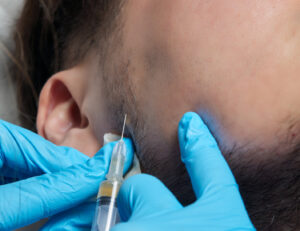
FUT Hair Transplant
Surgical technique for hair loss treatment in men and women
Follicular Unit Transplantation, or FUT is a technique for treating hair loss in both men and women. It is one of the two primary methods for extracting hair follicles during the transplant procedure.
The other hair transplant option is FUE Hair Transplant.
What is FUT hair transplant?
Just like FUE hair transplant, the idea of FUT hair transplant is to harvest healthy hair follicles from a part of your body (usually the back of your scalp) to the recipient area, where it is experiencing hair thinning. In FUT hair transplant procedure, a linear strip of hair from the donor area is removed with a scalpel. This procedure is quick and simple that usually takes about 30 minutes. The doctor proceeds to close the wound with sutures.
The strip of hair is passed to a team of technicians with a high-powered microscope to separate the strip of hair into individual follicular grafts.
When the follicular grafts are ready, the doctor makes small incisions on the recipient site using a needle. The medical team then proceeds to strategically place each follicular graft one by one into each follicle.
Can hair transplant be performed on other areas other than the scalp?
Absolutely. In fact, hair transplant procedure is so versatile that it can be performed on mustache, beards, sideburns, goatee, and eyebrows. Hair transplant can also be performed to conceal unsightly scars on the face or scalp.
Why does my transplanted hair fall out?
Transplanted hair may fall out after a hair transplant due to a normal process known as shock loss or shedding. This usually happens within the first few weeks after the procedure, when the transplanted hair shafts fall out while the hair follicles remain beneath the scalp.
This can be worrying, but in many cases, it is an expected part of the hair growth cycle. The transplanted follicles enter a resting phase before new hair begins to grow again. New growth typically starts gradually over the next few months, with visible improvement becoming more noticeable over time.
However, hair shedding can also be influenced by other factors such as scalp inflammation, poor wound healing, infection, excessive trauma to the grafts, underlying hair loss progression, nutritional deficiencies, stress, or hormonal changes. It is also important to protect the scalp and follow proper aftercare instructions after the procedure to support healthy recovery.
In most cases, transplanted hair shedding does not mean the treatment has failed. If the shedding is severe, persistent, or accompanied by redness, pain, swelling, or discharge, it is advisable to consult your hair transplant doctor for proper assessment.
Does FUT Hair Transplant Cause Permanent Scarring?
FUT hair transplant may leave a permanent linear scar at the donor area, usually at the back of the scalp where the strip of hair-bearing skin is removed.
In FUT, also known as strip hair transplant, the donor area is closed with stitches after the strip is taken. Once healed, this usually results in a fine line scar. For many patients, the scar can be well concealed when the surrounding hair is kept at a suitable length. However, it may become more visible if the hair is cut very short, such as with a close fade or shaved hairstyle.
The appearance of the scar depends on several factors, including surgical technique, wound healing, skin tension, individual scarring tendency, and aftercare. Some patients may heal with a very fine scar, while others may develop a wider or more noticeable scar.
Patients who prefer to keep their hair very short may wish to discuss whether FUE hair transplant is more suitable, as FUE typically leaves multiple tiny dot-like scars instead of one linear scar. During consultation, the doctor can assess your donor area, hairstyle preference, hair density, and suitability before recommending the most appropriate hair transplant technique.
What are the risks of FUT Hair Transplant?
FUT hair transplant is a minimally-invasive procedure without major adverse side effects. Just like any medical procedure, there will be some elements of risks and/or minor side effects which can be easily managed. Some risks include:
- Bleeding at the wound sites
- Infection
- Inflammation of the hair follicles
- Prolonged numbness on the donor and recipient areas
- Swelling and bruising
- Failure of hair follicles
You can expect healthy hair growth in the recipient areas for at least 5 to 10 years. You may still continue to experience hair loss in the same area after several years. If so, you may repeat the hair transplant procedure again, depending on whether you have enough hair to harvest from the donor site.
For more specific risks that may experience, speak to your doctor to find out more.
Benefits
-
Long-lasting hair growth with thicker, fuller hair -
Improved appearance -
Minimal maintenance required -
Convenient as it is a one-time treatment -
Cost-efficient -
High success rate -
No long-term medication required