


Dark Eye Circles Vs. Eye Bags: Cost, Surgery, And Other Facts
Dark eye circles can make the face appear tired even after a full night’s rest. However, under-eye darkness is not a single condition and cannot always be corrected using one treatment.
Dark circles may be caused by pigmentation, visible blood vessels, thin skin, under-eye hollowness, facial structure, skin laxity or a combination of several factors. Effective dark eye circle treatment therefore begins by identifying the main cause.
At Radium Medical Aesthetics, our doctors assess the colour, skin quality, facial volume and structure of the under-eye area before recommending treatment. Depending on the findings, a personalised plan may include laser treatment, polynucleotide injections, under-eye fillers, XERF Eye, skincare or a combination of approaches.
What Are Dark Eye Circles?
Dark eye circles refer to visible darkness or shadowing beneath the eyes.
They may appear:
- Brown or grey
- Blue or purple
- Sunken or shadowed
- Crepey and tired-looking
- Puffy with a darker fold beneath the eye
- More obvious under certain lighting
The colour and appearance can provide clues about the underlying cause, but a proper assessment is still needed before treatment.
Periorbital dark circles are generally considered multifactorial. Published reviews describe possible contributors including pigmentation, visible blood vessels, thin skin, facial anatomy, shadowing, allergies, rubbing and hereditary factors.

What Causes Dark Eye Circles?
GENETICS AND FACIAL ANATOMY Some people naturally have deeper tear troughs, thinner under-eye skin or more visible pigmentation around the eyes.
These features may be present from a young age and can become more noticeable with ageing.
PIGMENTATION Excess melanin may cause brown or grey darkness beneath the eyes.
Pigmented dark circles may be influenced by:
- Genetics
- Sun exposure
- Repeated eye rubbing
- Inflammation
- Allergies or eczema
- Previous irritation
- Post-inflammatory hyperpigmentation
VISIBLE BLOOD VESSELS The skin beneath the eyes is thin, so underlying blood vessels may create a blue, purple or reddish appearance.
This may become more obvious when the skin becomes thinner with age.
UNDER-EYE HOLLOWNESS Loss of volume beneath the eyes can create a groove between the lower eyelid and cheek.
Light falling across this depression creates a shadow that may look like pigmentation, even when the skin itself is not particularly dark.
THIN OR CREPEY SKIN Age-related collagen loss can make the under-eye skin thinner, less elastic and more translucent.
This may make vessels, muscle and deeper structures more visible.
EYE BAGS AND PUFFINESS Prominent eye bags may cast a shadow beneath the lower eyelid, making the area appear darker.
Temporary puffiness caused by fluid retention may also make shadows more visible, particularly in the morning.
AGEING Ageing may affect the under-eye area through:
- Collagen loss
- Thinning skin
- Reduced elasticity
- Facial volume changes
- Fat-pad prominence
- Bone and structural changes
- Increased shadowing
LACK OF SLEEP AND LIFESTYLE FACTORS Lack of sleep does not necessarily cause every case of persistent dark eye circles, but it may make the area appear duller, paler, puffier or more sunken.
High salt intake, dehydration, smoking, alcohol consumption and prolonged sun exposure may also worsen the overall appearance.
FREQUENT EYE RUBBING Repeated rubbing can cause irritation and inflammation and may contribute to pigmentation around the eyes.
Patients with allergies or eczema may be especially prone to rubbing.

Types of Dark Eye Circles
Dark eye circles can broadly be classified according to their main cause.
PIGMENTED DARK CIRCLES Pigmented dark circles usually appear brown or grey.
They may be associated with:
- Genetics
- Sun exposure
- Repeated rubbing
- Allergic or inflammatory skin conditions
- Post-inflammatory pigmentation
Possible treatment approaches may include topical skincare, sun protection and selected pigment-focused laser treatments.
VASCULAR DARK CIRCLES Vascular dark circles may appear blue, purple or reddish because blood vessels are visible through thin skin.
Possible approaches may include:
- Vascular laser assessment
- Treatments to improve skin quality
- Polynucleotide treatment
- Collagen-supporting procedures
STRUCTURAL DARK CIRCLES Structural dark circles are caused mainly by hollowness or facial anatomy.
The darkness is produced by shadowing rather than pigment alone.
Possible treatment approaches may include:
- Under-eye fillers in suitable patients
- Support of the upper cheek
- Skin-quality treatments
- Combination treatment
DARK CIRCLES CAUSED BY THIN OR CREPEY SKIN When the under-eye skin becomes thin and less elastic, underlying structures may become more visible.
Possible approaches may include:
- Polynucleotide injections
- XERF Eye
- Fractional or collagen-stimulating laser treatment
- Other skin-quality procedures
MIXED DARK CIRCLES Many patients have more than one cause.
For example, pigmentation may coexist with:
- Under-eye hollowness
- Thin skin
- Eye bags
- Visible vessels
- Skin laxity
Combination treatment may therefore be more appropriate than relying on a single procedure.
Dark Eye Circles Versus Eye Bags
Dark circles and eye bags are different concerns, although they may occur together.
DARK EYE CIRCLES Dark circles mainly involve:
- Pigmentation
- Visible blood vessels
- Thin skin
- Hollowness
- Structural shadowing
EYE BAGS Eye bags mainly involve:
- Protruding fat
- Loose skin
- Fluid retention
- Weakening of supporting tissues
- A combination of these changes
Eye bags may cast shadows that make dark circles appear worse. However, a pigmentation treatment will not remove a prominent fat-based eye bag, and a tightening treatment will not necessarily remove brown pigmentation.

How Do I Know What Type of Dark Circles I Have?
A doctor may assess:
- Whether the darkness is brown, grey, blue or purple
- Whether the colour changes when the skin is stretched
- The depth of the tear trough
- Skin thickness
- Under-eye volume
- Eye-bag prominence
- Visible blood vessels
- Skin laxity
- History of allergies or eczema
- Previous treatments
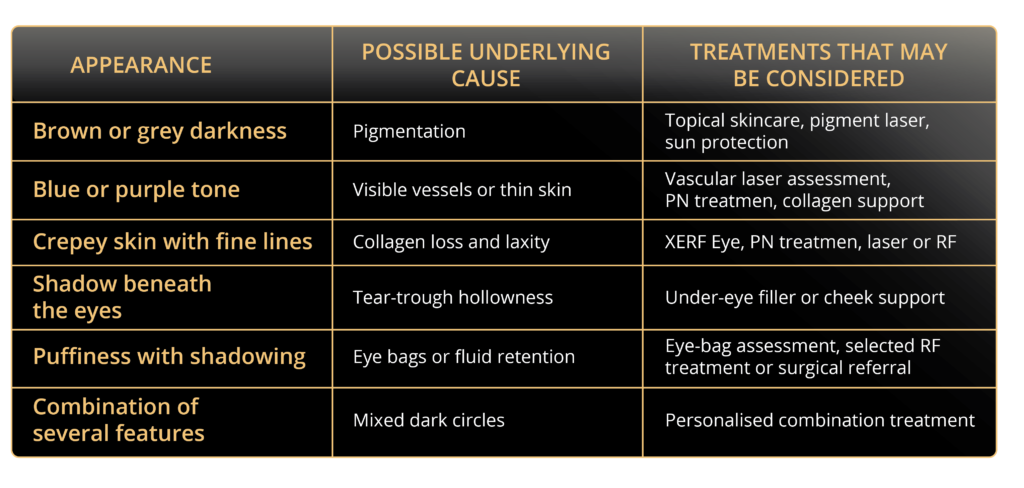
The following table is a general guide only.
Laser Treatment for Dark Eye Circles in Singapore
The most appropriate treatment depends on the underlying cause.
PIGMENTATION-FOCUSED LASERS Pigmentation lasers may be considered when excess melanin is contributing to brown or grey under-eye darkness.
The laser delivers energy that is absorbed by pigment, allowing it to be gradually cleared by the body.
Several sessions may be required, and conservative treatment settings are important because the under-eye skin is delicate.
VASCULAR LASERS Vascular lasers may be considered when visible blood vessels or redness contribute to the dark appearance.
These lasers are different from pigment-focused devices and should be selected according to the colour and depth of the vessels.
COLLAGEN-STIMULATING LASER TREATMENTS Fractional or non-ablative laser procedures may help improve thin skin, fine lines and crepey texture by supporting collagen renewal.
They do not directly replace lost volume or remove prominent eye bags.
At Radium, the selected dark eye circle laser treatment will depend on whether the main concern is pigment, vessels, texture or skin quality.
POLYNUCLEOTIDE EYE TREATMENT Polynucleotide treatments are injectable procedures intended to support skin quality and repair.
They may be considered when dark circles are associated with:
- Thin under-eye skin
- Fine lines
- Crepey texture
- Reduced elasticity
- Poorly hydrated-looking skin
Polynucleotides do not act like traditional volumising fillers and do not directly remove pigmentation.
Results generally develop gradually over a series of treatments.
UNDEREYE FILLERS Hyaluronic acid fillers may be considered when tear-trough hollowness creates structural shadowing beneath the eyes.
By restoring selected areas of volume, filler may soften the transition between the lower eyelid and cheek.
Under-eye filler is not suitable for everyone.
It may be unsuitable for patients with:
- Prominent eye bags
- Fluid retention
- Very thin skin
- Significant skin laxity
- Certain facial structures
- Previous filler complications
The under-eye area is delicate, and treatment should be conservative.
XERF EYE Eye lifting treatment with XERF uses controlled radiofrequency energy to support collagen remodelling and improve mild skin laxity around selected parts of the eye area.
It may be considered when dark circles are made more noticeable by:
- Crepey under-eye skin
- Fine lines
- Mild upper- or lower-eyelid laxity
- Reduced firmness around the eye contour
XERF Eye does not directly remove pigmentation, replace significant volume loss or remove prominent fat-based eye bags.
At Radium, XERF Eye is performed using a dedicated treatment tip designed for the smaller contours around the upper and lower eye area.

Treatments for Eye Bags
When prominent eye bags are creating shadows beneath the eyes, treatment should focus on the cause of the eye bags.
Possible options may include:
- Skin-tightening treatment for mild laxity
- Selected radiofrequency procedures
- Treatment for fluid retention where appropriate
- Surgical assessment for significant fat protrusion or excess skin
A consultation is needed to distinguish eye bags from hollowness, pigmentation and temporary puffiness.
BOTULINUM TOXIN FOR CROW’S FEET Botulinum toxin may be considered when wrinkles around the outer eyes are caused mainly by repeated muscle movement.
It may soften dynamic crow’s feet, but it does not directly treat pigmentation, under-eye hollowness or eye bags.
SKINCARE FOR DARK EYE CIRCLES Skincare may help support the under-eye area, especially when dryness, early pigmentation or photoageing are contributing factors.
Depending on suitability, products may contain:
- Vitamin C
- Niacinamide
- Retinoids
- Peptides
- Caffeine
- Moisturising ingredients
- Sunscreen
Eye products should be introduced carefully because the skin around the eyes is easily irritated.
Skincare alone is unlikely to fully correct deep hollowness, prominent eye bags or significant structural shadowing.
Can Home Remedies Remove Dark Eye Circles?
Home measures may help when the concern is temporary puffiness, fatigue or fluid retention.
These may include:
- Getting sufficient sleep
- Reducing excessive salt intake
- Staying hydrated
- Applying a cold compress
- Sleeping with the head slightly elevated
- Avoiding repeated rubbing
- Managing allergies appropriately
- Using daily sun protection
However, home remedies cannot remove inherited pigmentation, significant tear-trough hollowing, protruding eye-bag fat or substantial skin laxity.
Can Dark Eye Circles Be Removed Permanently?
Dark eye circles can often be improved, but permanent and complete removal may not be realistic.
Results depend on:
- The underlying cause
- Genetics
- Facial anatomy
- Skin thickness
- Ageing
- Lifestyle
- Treatment selected
- Individual response
- Maintenance and sun protection
Some causes, such as structural shadowing or age-related collagen loss, may require ongoing maintenance.
How Much Does Dark Eye Circle Removal Cost in Singapore?
Dark eye circle treatment in Singapore may range from several hundred dollars for a single laser or skin-rejuvenation session to approximately $800 to $2,000 or more for injectable or combination treatments.
The final cost depends on:
- The cause of the dark circles
- Treatment selected
- Number of sessions
- Product or device used
- Whether more than one concern is treated
- Whether combination treatment is required
Patients with mixed pigmentation, hollowness, thin skin and laxity may require more than one treatment approach.
The final treatment plan and quotation will be advised after consultation.
Frequently Asked Questions
WHAT IS THE BEST TREATMENT FOR DARK EYE CIRCLES? There is no single best treatment for every patient.
The appropriate option depends on whether the dark circles are caused mainly by pigmentation, vessels, thin skin, hollowness, eye bags or a combination of factors.
CAN LASER REMOVE DARK EYE CIRCLES? Laser treatment may help when pigmentation, visible vessels or skin quality are contributing factors.
It will not correct significant hollowness or remove prominent eye bags.
DOES UNDER-EYE FILLER HELP DARK CIRCLES? Under-eye filler may help when structural hollowness creates shadowing.
It does not directly remove pigmentation or visible blood vessels.
CAN XERF EYE IMPROVE DARK CIRCLES? XERF Eye may improve mild laxity and crepey skin that contribute to a tired appearance.
It does not directly remove pigment or restore significant lost volume.
IS REJURAN OR POLYNUCLEOTIDE TREATMENT SUITABLE FOR DARK CIRCLES? Polynucleotide treatment may be considered for thin, crepey or poorly hydrated-looking under-eye skin.
It does not act as a traditional filler and does not directly remove pigment.
WHAT IS THE DIFFERENCE BETWEEN EYE BAGS AND DARK EYE CIRCLES? Eye bags usually involve puffiness, protruding fat, loose skin or fluid retention.
Dark circles involve pigmentation, visible vessels, thin skin or structural shadowing. Both concerns may be present together.
CAN LACK OF SLEEP CAUSE DARK CIRCLES? Lack of sleep may make existing dark circles, pallor, puffiness or hollowness appear more obvious.
Persistent dark circles often have additional genetic, pigmentary or structural causes.
CAN DARK CIRCLES RETURN AFTER TREATMENT? Yes. Genetics, sun exposure, allergies, ageing, volume changes and lifestyle factors may cause the appearance to recur or become more noticeable over time.
IS DARK EYE CIRCLE TREATMENT SUITABLE FOR DARKER SKIN TONES? Treatment may be suitable, but laser choice and settings should be selected carefully because some patients have a higher risk of post-inflammatory pigmentation.
HOW MUCH DOES DARK EYE CIRCLE REMOVAL COST? The price depends on the underlying cause, treatment selected and number of sessions required.
A personalised quotation will be provided after assessment.


