CellREDM Singapore: Human Collagen ECM Skin Booster Explained
Skin boosters have evolved considerably over the past few years. While earlier treatments largely focused on hydration or stimulating the skin to produce more collagen, a newer category of treatment takes a different approach: supplying components of the skin’s own structural framework directly.
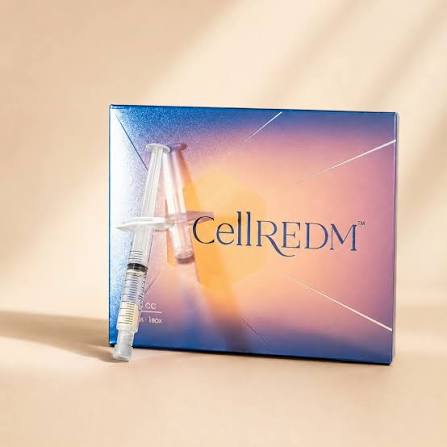
CellREDM is an extracellular matrix, or ECM, skin booster developed using human acellular dermal matrix (hADM). It contains naturally occurring components found within the dermis, including collagen, elastin and glycosaminoglycans. But what exactly does this mean, and how is CellREDM different from conventional skin boosters?
What Is CellREDM?
CellREDM is a collagen and extracellular matrix-based injectable treatment designed to support the structure and quality of the dermis.
To understand how it works, it helps to first understand the extracellular matrix (ECM).
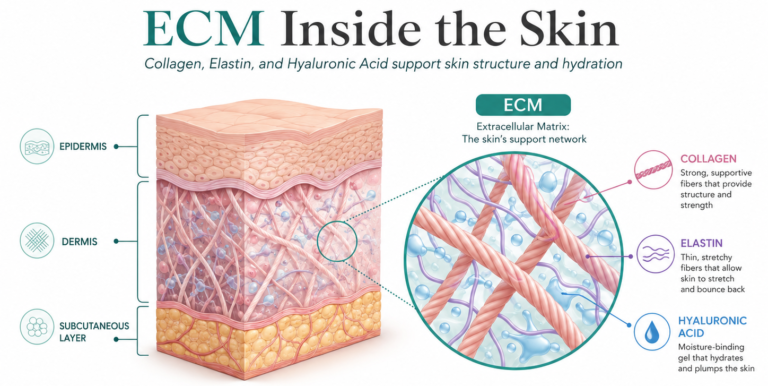
The dermis is not made up of skin cells alone. Surrounding these cells is an intricate supporting network known as the extracellular matrix.
The ECM contains structural components including:
- Collagen, which contributes to skin strength, density and firmness
- Elastin, which helps skin stretch and return to its original shape
- Glycosaminoglycans (GAGs), which contribute to hydration and the environment surrounding skin cells
Together, these components form an important part of the structural framework supporting healthy skin.
With ageing and environmental damage, the composition and organisation of the dermal extracellular matrix gradually change. This contributes to common concerns such as loss of elasticity, thinner-looking skin, fine lines and changes in skin texture.
CellREDM takes a different approach from treatments that simply signal the body to manufacture more collagen. It introduces processed ECM components directly into the skin.
Where Is CellREDM Derived From?
One of the most frequently asked questions about CellREDM is where its collagen comes from.
CellREDM is derived from human acellular dermal matrix, commonly abbreviated as hADM.
The material originates from donated human dermal tissue that undergoes processing to remove cells and potentially immunogenic cellular components while preserving elements of the extracellular matrix.
What remains is an acellular structural matrix containing components such as collagen, elastin and glycosaminoglycans.
The word “acellular” is important.
CellREDM does not involve injecting living donor skin cells into the face. Rather, cellular material is removed during processing, leaving behind components of the dermal extracellular matrix.
This technology is different from recombinant collagen and is also different from animal-derived collagen.
Is CellREDM Human Collagen?
CellREDM is often described as a human-derived collagen booster, although this description only tells part of the story.
Rather than containing collagen alone, CellREDM is based on human dermal extracellular matrix.
Its composition therefore includes a combination of ECM components, including:
COLLAGEN Provides much of the tensile strength and structural framework of the dermis.
ELASTIN Helps support skin elasticity and resilience.
GLYCOSAMINOGLYCANS These molecules interact with water and other components of the extracellular matrix and contribute to the hydrated environment of the dermis.
This combination is what distinguishes an ECM-based treatment from a simple collagen injection.
How Does CellREDM Work?
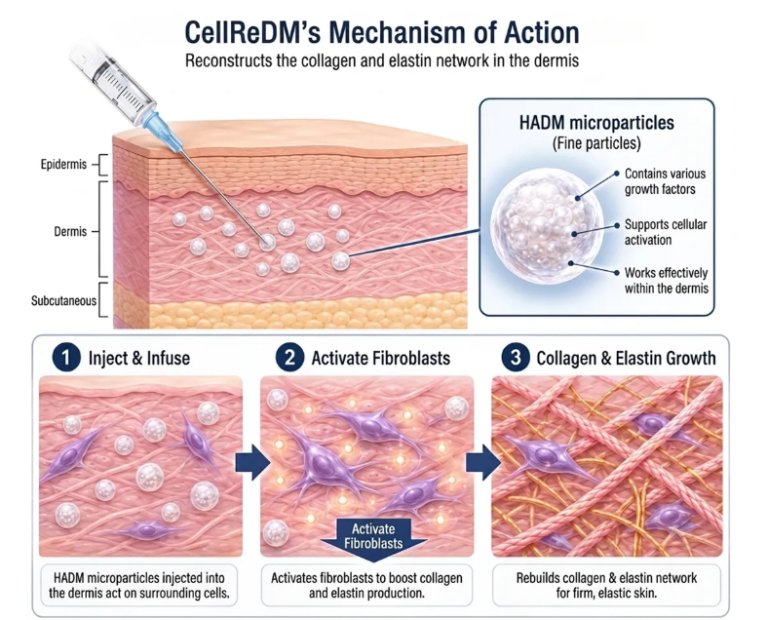
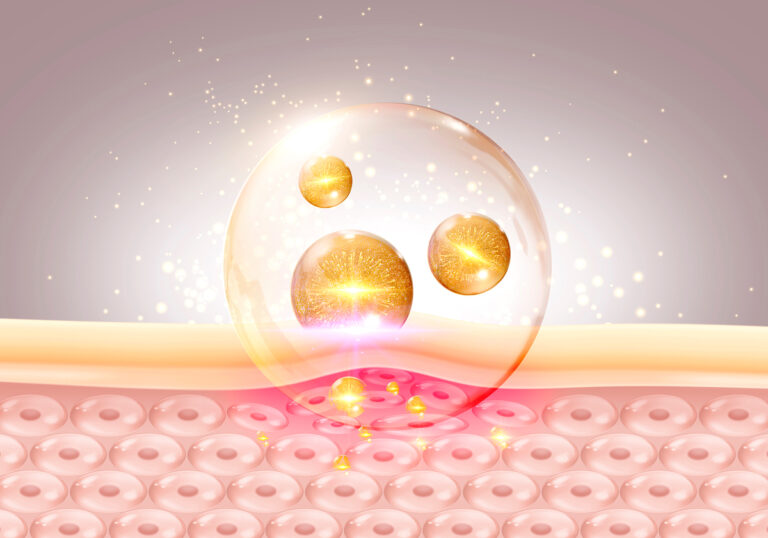
CellREDM works by introducing micronised extracellular-matrix material into the dermal layer of the skin.
According to available product information, CellREDM uses approximately 75-micrometre particles, allowing the material to be distributed through the treated tissue.
Once placed within the skin, the aim is for the ECM components to act as supplementary structural material within the dermal environment.
A useful way of understanding the concept is to compare the dermis to the framework supporting a building.
Skin cells are important, but they require an organised surrounding structure.
Collagen provides much of this framework. Elastin contributes flexibility, while glycosaminoglycans help support hydration and the extracellular environment.
CellREDM therefore focuses on supporting the dermal matrix itself, rather than simply adding superficial hydration.
CellREDM vs Collagen-Stimulating Skin Boosters
This is one of the most interesting differences.
Many injectable skin treatments work primarily by stimulating your own cells to produce more collagen.
CellREDM takes a more direct approach by introducing collagen and other ECM components into the skin.
For example, polynucleotide treatments such as PN skin boosters are generally used to support cellular repair and stimulate regenerative processes.
Biostimulatory injectables, meanwhile, work by triggering a biological response that encourages collagen production over time.
CellREDM does not rely entirely on this signalling approach.
Instead, its fundamental concept is to supply components of the extracellular matrix directly to the dermis.
That does not necessarily mean one category is superior to another. They are simply different approaches, and treatment selection should depend on the patient’s skin condition and treatment objectives.
What Are the Benefits of CellREDM?
Because CellREDM is intended to support the extracellular matrix of the dermis, it may be considered for several common signs of skin ageing.
IMPROVE SKIN FIRMNESS Collagen is one of the main structural proteins within the dermis. By providing collagen-containing extracellular matrix components directly to the skin, CellREDM may help improve the appearance of skin that has begun to feel less firm or resilient.
SUPPORT SKIN ELASTICITY Healthy skin needs both strength and flexibility. While collagen provides structural support, elastin contributes to the skin’s ability to stretch and recoil. As CellREDM contains components of the native dermal ECM, including elastin, treatment may help support overall skin elasticity.
IMPROVE FINE LINES Fine lines can become more visible as the dermal structure becomes thinner and collagen content decreases. Improving dermal support may soften the appearance of superficial fine lines and create smoother-looking skin. It should not, however, be confused with a conventional dermal filler designed to correct deeper folds or restore significant facial volume.
IMPROVE SKIN TEXTURE Changes in collagen organisation and dermal structure can contribute to uneven or crepey-looking skin. By supporting the extracellular matrix, CellREDM may help improve overall skin texture and create smoother-looking skin.
SUPPORT SKIN DENSITY Loss of collagen is one of the characteristics of ageing skin. Rather than simply providing surface hydration, ECM treatments are intended to work within the dermal environment. For patients concerned about thin or progressively less resilient skin, improving dermal support may therefore be particularly relevant.
IMPROVE HYDRATION AND SKIN QUALITY Glycosaminoglycans are naturally present within the extracellular matrix and interact strongly with water. For this reason, supporting the ECM may also contribute to better hydration and an improvement in overall skin quality. The objective is therefore not simply to make the skin look fuller, but to improve several aspects of skin quality simultaneously.
Is CellREDM the Same as a Dermal Filler?
No. Although CellREDM may provide some degree of subtle plumping because material is being introduced into the dermis, it should not be considered a substitute for a traditional hyaluronic acid filler.
Fillers are commonly used to:
- restore facial volume
- enhance facial contours
- correct deeper folds
- augment areas such as the chin, lips or cheeks
CellREDM is primarily a skin-quality and dermal-support treatment. The objective is generally a gradual improvement in characteristics such as firmness, elasticity, texture and skin quality rather than obvious facial reshaping.
Is CellREDM the Same as Rejuran?
No. The two belong to different categories.
Rejuran contains polynucleotides (PN), traditionally derived from purified salmon DNA fragments. PN treatments are used to support skin repair and regenerative processes.
CellREDM, in contrast, is based on human acellular dermal matrix and supplies extracellular-matrix components such as collagen, elastin and GAGs directly.
A simplified comparison would be:
PN TREATMENTS support and signal regenerative processes.
CellREDM supplies components of the dermal extracellular matrix.
Both may ultimately be used with the goal of improving skin quality, but they achieve this through different biological approaches.
Is CellREDM an Exosome Treatment?
No. Exosomes are microscopic extracellular vesicles involved in communication between cells. They contain signalling molecules that can influence cellular behaviour.
CellREDM is fundamentally different. It is based on human acellular dermal matrix, meaning its focus is on structural extracellular-matrix components rather than extracellular signalling vesicles. This distinction is important because terms such as exosomes, PN, PDRN, collagen boosters and ECM boosters are sometimes used interchangeably in beauty marketing even though they describe very different materials.
Which Areas Can CellREDM Treat?
Depending on individual anatomy and the doctor’s assessment, ECM-based treatments may potentially be considered for areas where skin quality, elasticity or dermal support has declined.
These may include the:
- face
- cheeks
- forehead
- areas with fine lines
- neck
- delicate areas where thinner skin is a concern
The appropriate injection technique, depth and quantity should always be determined by the treating doctor.
Who May Consider CellREDM?
CellREDM may appeal particularly to patients who notice:
- decreasing skin elasticity
- early fine lines
- thinner or less resilient skin
- uneven skin texture
- reduced skin firmness
- declining overall skin quality
- a preference for subtle rather than dramatic facial changes
It may also be considered by patients who are interested in collagen-focused treatments but do not necessarily require the volumising effect of a conventional filler.
When Will You See Results From CellREDM?
Results from skin-quality treatments should generally be assessed progressively rather than immediately.
Some temporary fullness may occur after injection simply because fluid and treatment material have been introduced into the skin. The more meaningful changes in skin texture, firmness and overall quality should be evaluated after the initial swelling has settled and the treatment has integrated with the surrounding tissue.
Individual response varies considerably depending on factors such as age, skin condition, treatment area and the amount of product used. A doctor may also recommend a treatment series rather than a single session depending on the patient’s objectives.
How Long Does CellREDM Last?
This is an area where patients should be careful about overly specific marketing claims.
CellREDM is relatively new compared with established injectables such as hyaluronic acid fillers and polynucleotides, and published CellREDM-specific clinical data on long-term outcomes remains limited.
Human-derived extracellular-matrix material is gradually remodelled and absorbed by the body rather than remaining permanently within the skin.
How long visible improvement lasts may therefore vary considerably between patients. For this reason, treatment frequency and maintenance should be personalised rather than assuming that every patient will obtain the same duration of effect.
Is Human-Derived CellREDM Safe?
The concept of a human-derived injectable understandably raises questions.
CellREDM uses acellular human dermal matrix. The manufacturing process is designed to remove cellular material while retaining extracellular-matrix components. HansBiomed, the developer of CellREDM, has extensive experience in human tissue-derived biomaterials and tissue banking. However, as with any injectable procedure, treatment is not completely risk-free.
Potential effects associated with injection can include:
- redness
- swelling
- tenderness
- bruising
- temporary lumps or unevenness
- infection
- inflammatory reactions
- other uncommon injection-related complications
Patients should disclose medical conditions, medications, allergies and previous aesthetic procedures to their doctor before treatment.
CellREDM: A Different Approach to Skin Rejuvenation
Skin ageing is not simply a problem of dryness. Over time, changes occur within the deeper structural environment of the dermis, including collagen, elastin and other extracellular-matrix components.
This is why modern aesthetic medicine increasingly looks beyond simply “hydrating” the skin. CellREDM represents one of the newer approaches to skin rejuvenation by focusing on the extracellular matrix itself. Rather than relying solely on a signal that asks the skin to create more collagen, CellREDM introduces human-derived ECM components directly into the dermis.
For suitable patients, the objective is not to dramatically alter facial features but to improve the underlying quality, firmness, elasticity and structural support of the skin. As with any injectable treatment, however, the most appropriate treatment depends on the individual’s anatomy, degree of skin ageing and desired outcome.
A consultation with an experienced aesthetic doctor in Singapore is therefore important to determine whether CellREDM, another skin booster, a collagen-stimulating treatment or a combination approach is more suitable.
Frequently Asked Questions About CellREDM
WHAT IS CELLREDM MADE FROM? CellREDM is made from processed human acellular dermal matrix (hADM). It contains extracellular-matrix components including collagen, elastin and glycosaminoglycans.
IS CELLREDM DERIVED FROM SALMON? No. CellREDM is human tissue-derived. This differs from PN and PDRN treatments, which are commonly derived from purified salmon or trout DNA.
DOES CELLREDM CONTAIN HUMAN CELLS? It is an acellular dermal matrix. The processing is intended to remove cellular components while retaining components of the extracellular matrix.
DOES CELLREDUM STIMULATE COLLAGEN? CellREDM differs from a conventional collagen biostimulator because its central concept is to supply collagen-containing extracellular-matrix material directly. The interaction between implanted ECM and surrounding tissue may also contribute to tissue remodelling, but CellREDM should not simply be described as identical to conventional collagen stimulators.
IS CELLREDM A FILLER? No. CellREDM is primarily intended as an ECM or collagen skin booster rather than a conventional facial-contouring filler.
IS CELLREDM AN EXOSOME? No. CellREDM is derived from human acellular dermal matrix. Exosomes are extracellular signalling vesicles and represent a different category of treatment.
WHAT IS THE DIFFERENCE BETWEEN CELLREDM AND REJURAN? CellREDM supplies human-derived extracellular-matrix components including collagen and elastin. Rejuran contains polynucleotides and primarily works through regenerative signalling and tissue-repair pathways.
WHAT SKIN CONCERNS CAN CELLREDM POTENTIALLY IMPROVE? Depending on the patient’s skin condition, treatment may be considered for loss of firmness, reduced elasticity, fine lines, changes in texture, thinning skin and general deterioration in skin quality.
IS CELLREDM SUITABLE FOR EVERYONE? No aesthetic injectable is suitable for everyone. A medical consultation is required to assess skin condition, medical history and whether the expected benefit justifies the risks of treatment.