

Dermal Fillers Singapore | Facial Contouring & Rejuvenation

Aesthetic Treatments

Dermal Fillers Treatment in Singapore

Facial Contouring, Volume Restoration and Natural-Looking Rejuvenation

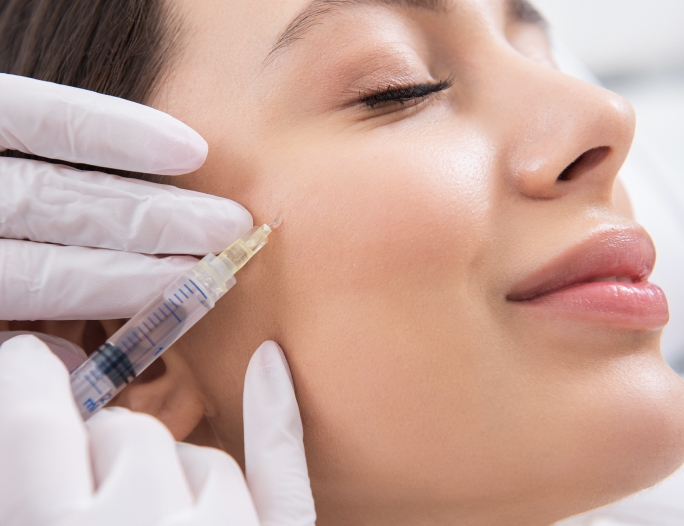
Dermal fillers are injectable treatments used to restore facial volume, improve selected contours and enhance facial proportions.

At Radium Medical Aesthetics, filler treatment begins with an assessment of facial structure, proportions, age-related changes and the underlying cause of the concern.

The objective is not simply to add volume.

In many patients, the most natural-looking result comes from understanding where support has been lost, where additional projection may improve balance, and where filler may not be necessary at all.

Dermal fillers may be considered for areas such as the:

  • cheeks
  • chin
  • jawline
  • temples
  • lips
  • under-eye area
  • nose

Treatment should be customised according to anatomy, treatment goals and the characteristics of the filler being used.

What Are Dermal Fillers?

Dermal fillers are injectable medical products designed to restore or add volume within selected areas of the face.

Many commonly used dermal fillers are made from hyaluronic acid, a substance naturally present within the body.

Other injectable products may use different materials and work in different ways.

Dermal fillers also vary in their physical characteristics, including:

  • firmness
  • elasticity
  • projection
  • tissue integration
  • structural support
  • longevity

For this reason, there is no single filler that is suitable for every area of the face.

A soft filler that integrates well in one area may not provide enough support in another, while a firmer product may be unsuitable for more delicate or mobile areas.

Product selection therefore depends on:

  • treatment area
  • skin thickness
  • facial anatomy
  • tissue movement
  • required projection
  • treatment objective

Why Does the Face Lose Volume with Age?

Facial ageing does not happen only at the skin surface.

Changes occur across multiple anatomical layers, including:

  • skin
  • fat compartments
  • ligaments
  • muscle
  • bone

Over time, fat may redistribute or diminish, supporting structures may weaken and changes in bone structure may alter facial proportions.

These changes can contribute to:

  • flatter cheeks
  • hollow temples
  • under-eye hollowing
  • deeper folds
  • reduced chin projection
  • less jawline definition
  • a heavier-looking lower face
  • changes in facial balance

Dermal fillers may be used selectively to restore support or volume where appropriate.

However, not every sign of facial ageing is caused by volume loss.

Loose skin, pigmentation, muscle-related lines and changes in skin quality may require different treatment approaches.

What Can Dermal Fillers Be Used For?

RESTORING LOST FACIAL VOLUME Age-related volume loss can contribute to hollowing and flattening in areas such as the cheeks and temples. Carefully placed filler may help restore selected areas of volume and improve transitions between different parts of the face.

IMPROVING FACIAL CONTOURS Fillers may be used to improve projection or definition in areas such as the chin, jawline and cheeks.

IMPROVING FACIAL PROPORTIONS Small structural changes can sometimes improve the relationship between different facial features. For example, chin projection may influence how the nose, lips and jawline appear in profile.

SOFTENING SELECTED LINES AND FOLDS Some folds become more noticeable because of changes in underlying support and volume. In suitable patients, restoring support around these areas may soften their appearance.

SUPPORTING AGEING FACIAL STRUCTURES Fillers can provide structural support in selected areas where volume loss has occurred. This does not mean fillers physically tighten loose skin in the same way as surgery or energy-based treatments. The effect is better understood as restoring selected areas of support where facial structure has changed.

Common Dermal Filler Treatment Areas

CHEEK FILLER The cheeks play an important role in facial structure and midface support.

Age-related changes can lead to:

  • flatter cheeks
  • reduced projection
  • more noticeable folds
  • changes in the transition between the lower eyelid and cheek

Cheek filler may be used selectively to restore contour and support. The aim should not necessarily be to create larger cheeks. In many patients, restoring lost structure conservatively produces a more natural-looking result than simply adding volume.

CHIN FILLER Chin shape and projection can influence the appearance of the entire lower face.

Chin filler may be used to improve:

  • projection
  • length
  • facial proportions
  • lower-face definition
  • profile balance

The chin should not be assessed in isolation. Its relationship with the nose, lips and jawline should be considered when planning treatment. Patients who would like more detail can read about chin filler treatment in Singapore.

JAWLINE FILLER Jawline filler may be used to improve selected aspects of lower-face definition.

Treatment may involve areas such as:

  • mandibular angle
  • jawline
  • pre-jowl region
  • chin

However, an indistinct jawline is not always caused by insufficient structure. Skin laxity, excess fat beneath the chin and facial shape may also contribute. In these situations, filler alone may not be the most appropriate treatment.

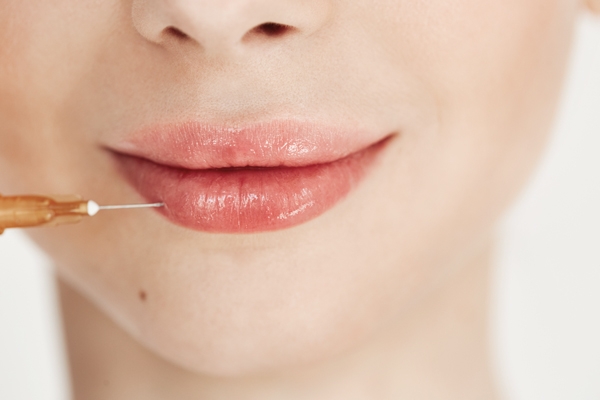
LIP FILLER Lip filler can be used for more than increasing lip size.

Treatment may aim to improve:

  • definition
  • shape
  • proportion
  • symmetry
  • age-related volume loss

The amount and placement of filler should be determined according to existing lip anatomy and overall facial proportions. Patients can learn more about lip filler treatment on our dedicated page.

TEMPLE FILLER Loss of volume around the temples can contribute to a hollow or more angular appearance. In selected patients, temple filler may help restore smoother transitions between the forehead, temples and cheeks. The temple is an anatomically complex area and requires careful assessment and injection technique.

UNDER-EYE AND TEAR TROUGH FILLER Hollowing beneath the eyes can create shadowing and make the eyes appear tired. In carefully selected patients, filler may be considered for certain forms of under-eye hollowing. However, not every dark circle or eye bag should be treated with filler.

Under-eye concerns may also result from:

  • pigmentation
  • thin skin
  • prominent blood vessels
  • fluid retention
  • fat prolapse
  • skin laxity

Patients prone to swelling may not be ideal candidates. A detailed assessment is therefore important before treatment in this area. Read more about under-eye and tear trough filler.

NOSE FILLER Nose filler may be used in selected patients to alter certain aspects of the nasal profile without surgery.

Possible treatment objectives may include improving:

  • bridge contour
  • selected irregularities
  • profile
  • tip appearance in suitable cases

The nose has complex vascular anatomy, and filler treatment in this area carries specific risks. A detailed discussion of benefits, limitations and possible complications should take place before treatment. Read more about nose filler in Singapore.

What Makes Dermal Fillers Look Natural?

Natural-looking filler treatment is not simply about using less product.

It depends on understanding:

  • facial anatomy
  • existing facial proportions
  • areas of genuine volume loss
  • structural support
  • product characteristics
  • injection depth
  • how different facial features relate to one another

One of the common reasons filler can look unnatural is when individual features are treated without considering the face as a whole.

For example, adding volume to the cheeks may not improve a heavy-looking lower face if the underlying concern is skin laxity rather than volume loss.

Similarly, increasing lip volume does not necessarily improve facial balance if the lips are already proportionate.

Good filler treatment includes knowing when not to add more filler.

More Filler Is Not Always Better

Facial ageing is complex.

A face that appears tired, heavy or less defined does not automatically require more volume.

Before recommending filler, a doctor should consider whether the concern is caused primarily by:

  • volume loss
  • structural deficiency
  • skin laxity
  • muscle activity
  • skin quality
  • changes in fat distribution
  • a combination of factors

If filler is unlikely to address the underlying concern, another treatment may be more appropriate.

The aim is not to fill every hollow or line.

It is to understand what has changed and treat only where doing so is likely to improve overall facial balance.

Can Dermal Fillers Lift the Face?

Dermal fillers are sometimes described as a “liquid facelift”.

This can be misleading if interpreted too literally.

Fillers cannot reproduce the effect of surgery and do not directly tighten loose skin.

However, age-related volume loss can reduce structural support in selected areas.

Where appropriate, restoring this support may improve facial contour and create the appearance of better structural balance.

The degree of improvement depends on:

  • facial anatomy
  • amount of volume loss
  • degree of skin laxity
  • treatment area
  • product selected

Patients with more significant laxity may benefit more from skin-tightening or lifting treatments rather than additional filler.

Are All Dermal Fillers the Same?

No.

Dermal fillers differ significantly in their physical properties.

Some are softer and integrate more naturally into mobile tissues, while others provide greater projection or structural support.

The choice of filler depends on factors such as:

  • treatment area
  • skin thickness
  • facial movement
  • degree of projection required
  • existing structure
  • desired longevity

Choosing a filler should therefore not be based only on brand name.

The product should be selected according to the area and treatment objective.

Dermal Filler vs Collagen Biostimulator

Dermal fillers and collagen biostimulators are both injectable treatments, but they do not work in the same way.

DERMAL FILLERS Dermal fillers are primarily used to:

  • restore volume
  • improve contours
  • provide structural support
  • create relatively immediate changes in projection or shape

COLLAGEN BIOSTIMULATORS Collagen biostimulators such as PCL collagen stimulators or CaHA collagen biostimulators are designed to stimulate gradual collagen production and improve selected aspects of tissue support and skin quality over time.

Depending on facial anatomy and treatment goals, a doctor may recommend one approach or a combination.

Dermal Filler vs Skin Booster: What Is the Difference?

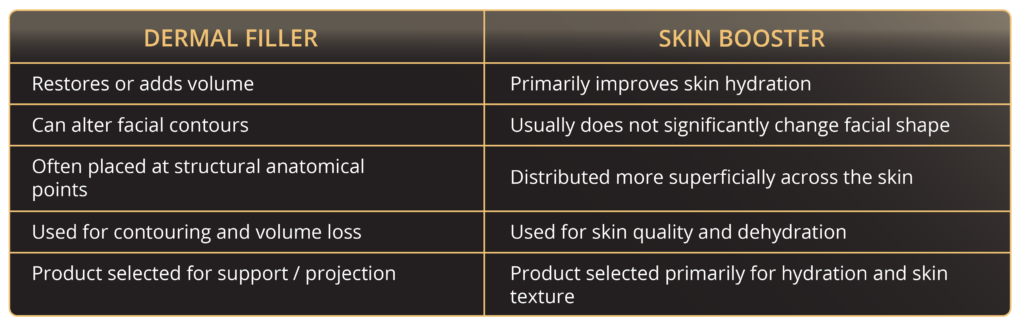
Dermal fillers and many skin boosters may both contain hyaluronic acid, but they serve different purposes.

Dermal fillers are generally used to restore volume, improve contours and provide structural support.

Skin boosters are usually used to improve hydration, skin quality and texture rather than significantly change facial shape.

Someone with dehydrated skin but good facial volume may benefit from a skin booster without needing filler.

Someone with structural volume loss may not obtain the desired improvement from a skin booster alone.

How Long Do Dermal Fillers Last?

Dermal fillers are temporary treatments.

Longevity varies according to:

  • product used
  • treatment area
  • amount injected
  • individual metabolism
  • facial movement
  • previous treatments

Highly mobile areas may behave differently from areas where filler is placed for structural support.

Your doctor can advise on expected longevity according to the product and treatment area selected.

What Are the Possible Risks of Dermal Fillers?

Dermal fillers are medical procedures and complications can occur.

Common temporary effects include:

  • swelling
  • bruising
  • tenderness
  • redness

Other possible complications may include:

  • infection
  • lumps or irregularities
  • persistent swelling
  • inflammatory reactions
  • migration
  • asymmetry

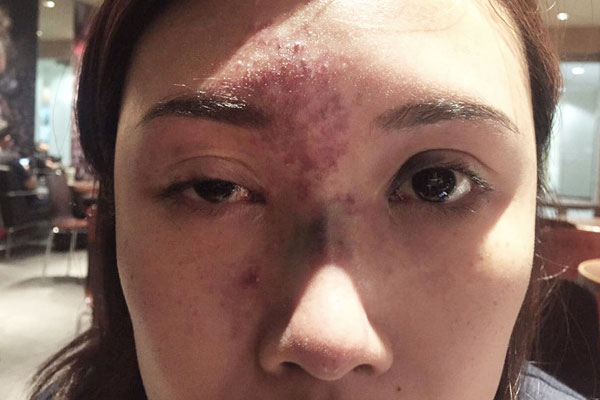
Rare but serious complications can occur if filler unintentionally enters or compresses a blood vessel.

This may affect blood supply to the skin and, in very rare cases involving particular facial areas, may cause more serious complications including visual impairment.

For this reason, knowledge of facial anatomy, appropriate injection technique and early recognition of complications are important.

Patients should contact the clinic promptly if they experience:

  • severe or worsening pain
  • unusual skin colour changes
  • visual symptoms
  • other unexpected symptoms after treatment

Dr Siew Tuck Wah's Approach to Dermal Fillers

Dr Siew Tuck Wah is the Medical Director of Radium Medical Aesthetics and has extensive experience in medical aesthetics and injectable treatments.

His approach to dermal fillers focuses on assessing the face as a whole rather than treating individual features in isolation.

Treatment planning considers:

  • facial proportions
  • areas of structural support
  • age-related changes
  • product characteristics
  • appropriate injection depth
  • treatment placement
  • the amount of filler required

The objective is to preserve the patient’s individual features and avoid creating an overfilled or standardised appearance.

Dr Siew has also been involved in training other doctors in injectable techniques.

How Long Do Dermal Fillers Last?

Dermal fillers are temporary treatments.

Longevity varies according to:

  • product used
  • treatment area
  • amount injected
  • individual metabolism
  • facial movement
  • previous treatments

Highly mobile areas may behave differently from areas where filler is placed for structural support.

Your doctor can advise on expected longevity according to the product and treatment area selected.

Is There Downtime After Dermal Filler Treatment?

Common temporary effects may include:

  • Redness
  • Swelling
  • Tenderness
  • Bruising
  • Mild asymmetry caused by swelling
  • Temporary firmness around injection sites

Most injection-related effects improve with time.

Bruising and swelling vary significantly between individuals and treatment areas.

Patients should allow adequate recovery time before important events.

What Are the Possible Risks of Dermal Fillers?

Dermal fillers are medical procedures and complications can occur.

Common temporary effects include:

  • swelling
  • bruising
  • tenderness
  • redness

Other possible complications may include:

  • infection
  • lumps or irregularities
  • persistent swelling
  • inflammatory reactions
  • migration
  • asymmetry

Rare but serious complications can occur if filler unintentionally enters or compresses a blood vessel.

This may affect blood supply to the skin and, in very rare cases involving particular facial areas, may cause more serious complications including visual impairment.

For this reason, knowledge of facial anatomy, appropriate injection technique and early recognition of complications are important.

Patients should contact the clinic promptly if they experience:

  • severe or worsening pain
  • unusual skin colour changes
  • visual symptoms
  • other unexpected symptoms after treatment

Who May Not Be Suitable for Dermal Fillers?

Dermal filler treatment may not be appropriate in certain situations.

Tell your doctor if you:

  • are pregnant or breastfeeding
  • have an active infection in the treatment area
  • have a history of significant allergic reactions
  • have an autoimmune or significant medical condition
  • are taking medication that affects bleeding or clotting
  • have previously experienced filler complications
  • already have filler in the treatment area
  • recently underwent another aesthetic procedure

Suitability should be determined during medical consultation.

What Should You Look for When Choosing a Filler Doctor in Singapore?

Patients often focus on which filler brand is being used.

The injector is equally important.

When choosing a doctor for dermal filler treatment, consider:

EXPERIENCE WITH FACIAL INJECTABLES Ask whether the doctor regularly performs filler procedures and has experience treating the area you are concerned about.

UNDERSTANDING OF FACIAL ANATOMY Filler treatment requires an understanding of facial structures and vascular anatomy.

WHOLE-FACE ASSESSMENT Treating one feature in isolation may sometimes create imbalance. The doctor should consider how the proposed change affects neighbouring features and facial proportions.

APPROPRIATE PRODUCT SELECTION Different fillers have different characteristics. The filler selected should suit the treatment area and intended outcome.

A CONSERVATIVE TREATMENT PHILOSOPHY More filler does not necessarily produce a better result. A doctor should be willing to recommend less treatment, or no filler, if additional volume is unlikely to improve the face.

ABILITY TO RECOGNISE AND MANAGE COMPLICATIONS Patients should understand what complications may occur and how the clinic manages them.

Frequently Asked Questions About Dermal Fillers in Singapore

Is Dermal Filler the Same as Botox?

No.

Dermal fillers primarily restore or add volume within selected facial areas.

Botulinum toxin works differently by reducing activity in selected muscles and is commonly used for expression-related lines or muscle-related facial concerns.

Which Filler Is Best?

There is no single filler that is best for every area of the face.

The appropriate product depends on the treatment area, anatomy, skin thickness, amount of support required and desired outcome.

Will Filler Make My Face Look Bigger?

Not necessarily.

Well-planned filler treatment may restore lost structure or improve facial proportions without making the face appear larger.

Overfilling, however, can create unnecessary heaviness or volume.

How Much Filler Do I Need?

The amount required varies considerably between individuals.

Treatment should be based on anatomy and treatment goals rather than a standard number of syringes.

Can Dermal Fillers Look Natural?

Yes.

Natural-looking results depend on appropriate assessment, product selection, placement and treatment volume.

How Often Should Dermal Fillers Be Repeated?

There is no fixed schedule.

Repeat treatment depends on the filler used, treatment area, individual metabolism and whether further treatment is required.

Benefits

  • checked
    Restore selected areas of facial volume
  • checked
    Improve facial contours and proportions
  • checked
    Enhance definition of selected facial features
  • checked
    Soften certain folds and lines
  • checked
    Provide structural support where volume has been lost
  • checked
    Minimal downtime for many patients
  • checked
    Customisable according to facial anatomy and treatment goals
  • checked
    Can be combined with other aesthetic treatments when appropriate

Best For

Men and women who want to improve facial contours, proportions or age-related volume loss with a non-surgical injectable treatment while maintaining a natural-looking result.

Book Now